Guide
best-couple-budget-spreadsheet-templates-free-2026
best-couple-budget-spreadsheet-templates-free-2026 article.
site_id: "budgeting-site" target_domain: "budgetingforcouples.com" primary_topic: "Budget Spreadsheet Templates for Couples"
title: "Best Couple Budget Spreadsheet Templates (Free 2026)" description: "Discover the best free couple budget spreadsheet templates for 2026. Compare features, see real examples, and start managing your household finances together." slug: "best-couple-budget-spreadsheet-templates-free-2026" publishedAt: "2026-04-24" dateModified: "2026-04-24" author: "Sarah Mitchell, CPA & Personal Finance Coach" category: "Budgeting for Couples" image: "/images/articles/best-couple-budget-spreadsheet-templates-free-2026-hero.jpg" og_title: "Best Couple Budget Spreadsheet Templates (Free 2026)" og_description: "Compare the top free couple budget spreadsheet templates for 2026. Includes Google Sheets, Excel, and printable options to manage finances together." og_image: "/images/articles/best-couple-budget-spreadsheet-templates-free-2026-og.jpg" og_site_name: "Budgeting for Couples" twitter_card: "summary_large_image" faq_schema: null article_schema: null
Best Couple Budget Spreadsheet Templates (Free 2026)
Managing household finances together is one of the most important skills a couple can develop — and the right spreadsheet template makes it dramatically easier. Whether you are just starting out or have been combining finances for years, a well-designed budget spreadsheet gives both partners a clear, shared view of where money is coming from and where it is going. These free templates work in Google Sheets and Excel, require no paid software, and take less than 30 minutes to set up.
Table of Contents
- Why a Budget Spreadsheet Works Better Than Apps for Couples
- Essential Features Every Couples Budget Spreadsheet Needs
- Top 5 Free Couple Budget Spreadsheet Templates (2026)
- How to Choose the Right Template for Your Household
- Step-by-Step: Setting Up Your Budget Spreadsheet in 30 Minutes
- Pro Tips: Making Your Budget Spreadsheet Work Long-Term
- Common Budget Spreadsheet Mistakes and How to Fix Them
- Frequently Asked Questions
- Sources & Methodology
Why a Budget Spreadsheet Works Better Than Apps for Couples
Budgeting apps dominate the personal finance space, but for couples managing money together, a spreadsheet often delivers better results. Here is why.
Apps are designed for individual users. When two people try to share a budgeting app account, they frequently run into sync issues, conflicting edits, and privacy concerns — particularly when one partner wants to keep certain spending categories personal. A shared spreadsheet solves this by giving both partners equal access while allowing individual privacy in specific cells or sheets.
Spreadsheets also offer complete customizability. Need a category for "date night fund" or "emergency home repairs"? You can add it instantly. In a budgeting app, you are often locked into the developer's categories, which may not reflect how your household actually spends money.
The third advantage is transparency. When both partners can see the same document in real time, conversations about money become factual rather than emotional. "We spent $400 on dining out last month" is harder to argue with than a vague sense that one partner is spending too freely.
Finally, spreadsheets are free. Most budgeting apps require a paid subscription to unlock the features that matter most for couples. Google Sheets and Microsoft Excel are free to use, fully featured, and accessible on any device.

Essential Features Every Couples Budget Spreadsheet Needs
Not all budget spreadsheets are created equal. Before choosing a template, make sure it includes these non-negotiable features.
Combined Income Tracking
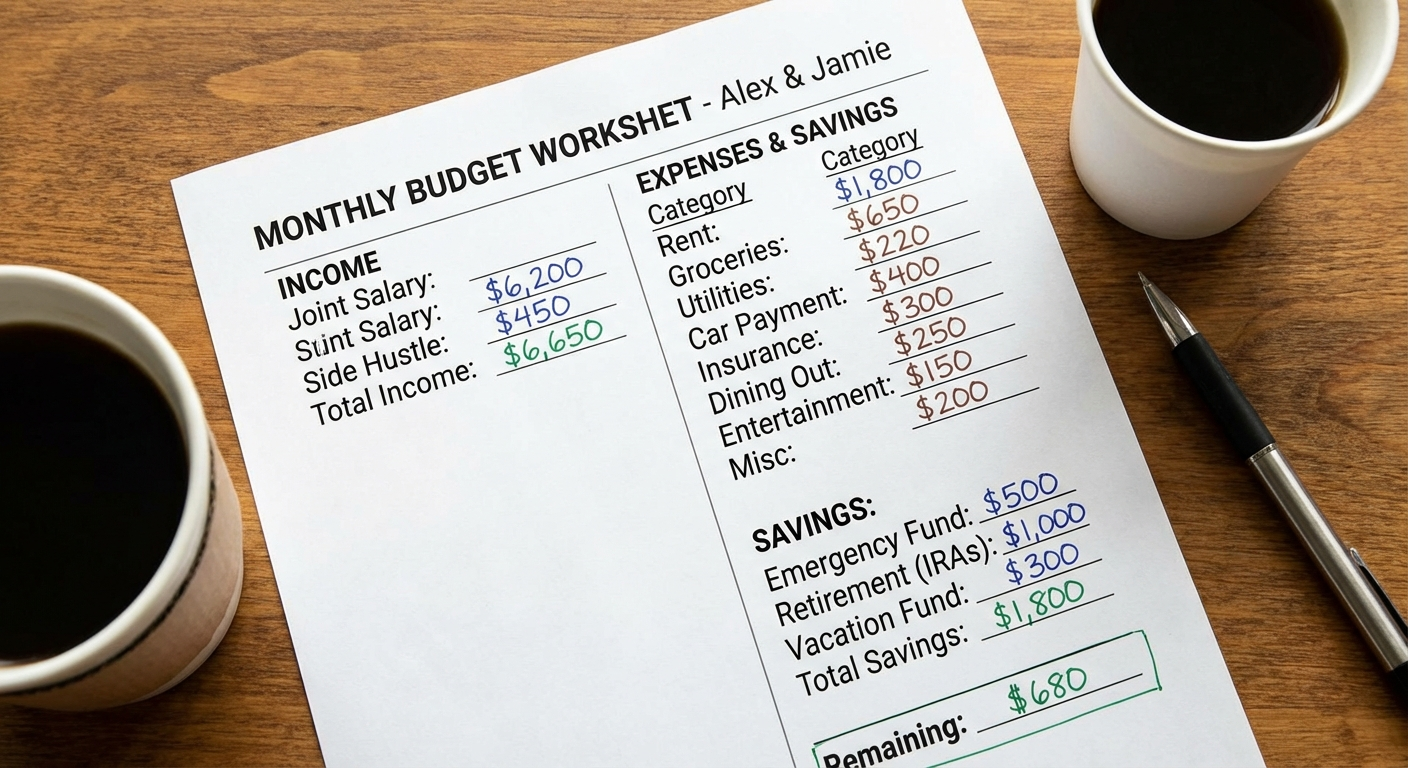
Your spreadsheet needs a dedicated section for both partners' income sources. This means separate lines for each person's salary, any side hustle income, dividends, rental income, or government benefits. The total combined income should be clearly visible at the top of the sheet.
Category-Based Expense Tracking
Expenses should be broken into clearly labelled categories. Essential categories include:
- Housing (rent or mortgage, property taxes, insurance, maintenance)
- Utilities (electricity, gas, water, internet, phone)
- Food (groceries, dining out, coffee shops)
- Transportation (car payments, fuel, public transit, rideshare)
- Healthcare (insurance premiums, out-of-pocket costs, medications)
- Debt payments (credit cards, student loans, car loans, personal loans)
- Entertainment and leisure
- Personal spending (clothing, grooming, hobbies)
- Savings and investments
Each partner should be able to log their own spending under the relevant category without friction. If one partner spends $45 at the grocery store, they should be able to record it in seconds — not navigate a complicated multi-step process.
Monthly vs. Actual Comparison
This is the feature most couples overlook. A good budget spreadsheet compares what you planned to spend in each category (budgeted amount) against what you actually spent (actual amount). The variance column tells you at a glance whether you are on track or overspending.
Savings Goals Tracker
Whether you are saving for a house deposit, a holiday, an emergency fund, or a new car, your spreadsheet should include a dedicated savings goals section. This shows how much you have saved toward each goal, how much you need each month to hit your target, and the projected completion date.
Debt Payoff Tracker
For couples managing student loans, car loans, credit card debt, or mortgages, a debt payoff tracker is essential. This section should show each debt balance, the interest rate, minimum monthly payment, and how much extra you are directing toward each debt. Seeing your debt shrink month by month is one of the most motivating features a budget spreadsheet can offer.
Visual Summary Dashboard
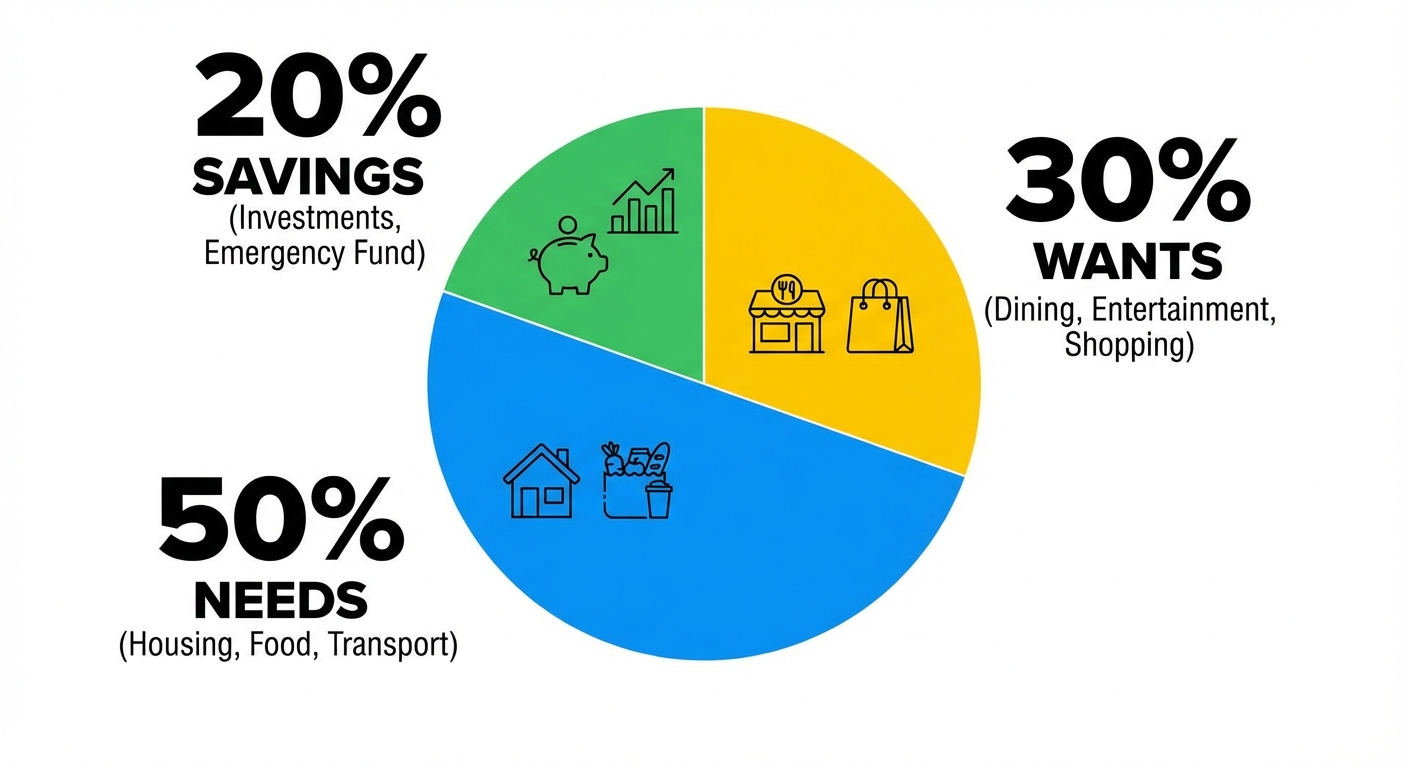
Numbers buried in rows and columns are hard to interpret quickly. A dashboard tab with charts — a spending-by-category pie chart, a month-by-month income vs. expenses line graph, and a savings progress bar — makes it easy for both partners to grasp the big picture in under 30 seconds.
Separate Personal Allowances
Healthy couple finances include a "no-questions-asked" personal spending allowance for each partner. This is a small, agreed-upon amount — typically $50 to $200 per month — that each partner can spend without needing to explain or justify it. The spreadsheet should have a line item for this in the budget so it is accounted for rather than being hidden or causing conflict.
Top 5 Free Couple Budget Spreadsheet Templates (2026)
The following templates represent the best free options available in 2026. Each has been evaluated on category coverage, ease of use, customizability, and whether it works on both Google Sheets and Excel.
1. Google Sheets Couple Budget Template (Best Overall)
Platform: Google Sheets (free) Access: google.com/sheets/about — create new, then search "couple budget" in template gallery
This template is the clear winner for most couples. It is entirely free, fully cloud-based so both partners access it from any device, and updates sync in real time. The structure is clean and intuitive: a "Budget" tab for income and expense entry, a "Transactions" tab for detailed logging, and a "Summary" dashboard with auto-generated charts.
The monthly budget sheet uses a zero-based budgeting approach — every dollar is assigned a job before the month begins. Categories are pre-built but fully customizable, and the template includes a "Available to Budget" row that updates automatically as you log expenses.
The visual dashboard shows spending by category as a pie chart and compares month-to-month trends. Both partners can edit simultaneously without overwriting each other's work.
Pros:
- 100% free, no subscription required
- Real-time sync across all devices
- Pre-built formulas require no spreadsheet knowledge
- Supports multiple currencies
- Auto-saves to Google Drive
Cons:
- Requires a Google account (free to create)
- Limited offline functionality without Google Sheets app installed
Best for: Couples who want a polished, zero-setup solution that works immediately on any device.
[INTERNAL LINK: joint-bank-account-guide -> Understanding Joint vs. Separate Accounts: What Every Couple Should Know]
2. Vertex42 (Amazon) Monthly Budget Planner (Best for Excel Users)
Platform: Microsoft Excel (free template, Excel required) Download: vertex42.com — search "monthly budget planner"
Vertex42 (Amazon) has been producing free Excel budget templates for over a decade, and their Monthly Budget Planner remains one of the most downloaded personal finance templates online. The spreadsheet is designed for a monthly budget cycle and includes a full income/expense tracker, category comparison charts, and a debt snowball calculator.
The template uses Excel's native SUM and conditional formatting functions to highlight overspending categories in red. It is fully unlocked — every formula is visible and editable, so you can customize it completely without restrictions.
A standout feature is the "Debt Snowball" tab, which automatically calculates payoff schedules for multiple debts based on extra monthly payments. This is particularly valuable for couples tackling student loans or credit card debt together.
Pros:
- No account creation required — download and use immediately
- Fully unlocked formulas — total customization
- Debt snowball calculator included
- Works in LibreOffice Calc (free) if you do not have Excel
- Multiple budget periods tracked on separate sheets
Cons:
- Requires desktop Excel or LibreOffice — not native mobile-friendly
- No real-time collaboration without OneDrive
Best for: Couples who prefer desktop Excel and want full control over their spreadsheet formulas.
3. Notion Couple Finance Template (Best for Minimalist Interface)
Platform: Notion (free for personal use) Access: notion.so — create free account, duplicate template
Notion has emerged as a popular alternative to spreadsheets for couple finances. While technically a database tool rather than a spreadsheet, Notion's flexibility makes it powerful for budget tracking. The Couple Finance template typically includes a dashboard with income sources, expense categories, savings goals board, and a debt tracking table.
What sets Notion apart is its ability to embed visual boards, link to other notes (such as financial goals or investment tracking), and create recurring reminder systems. Both partners can update their spending from any device, and changes log with timestamps so you can track exactly when entries were made.
The main limitation is that Notion lacks the auto-calculation depth of a true spreadsheet for complex financial modeling. But for day-to-day budget tracking and visual organization, it is an excellent tool.
Pros:
- Beautiful, minimalist interface
- Easy recurring reminders and check-ins built in
- Link budgets to other life documents and goals
- Fully mobile-friendly
- Free for personal use
Cons:
- Steeper learning curve if unfamiliar with Notion
- Less powerful calculations than Excel or Google Sheets
- Data export limited compared to spreadsheet formats
Best for: Tech-comfortable couples who love the Notion aesthetic and want an all-in-one life management system.
[INTERNAL LINK: budgeting-apps-guide -> The Best Budgeting Apps for Couples in 2026]
4. Tiller (Amazon) Money – Community Template (Best for Automation)
Platform: Google Sheets or Excel (free community template) Access: tillerHQ.com — free community templates available
Tiller (Amazon) is a paid service ($79/year) that automatically imports bank transactions into spreadsheets — but Tiller (Amazon) also offers free community-built templates that do not require a subscription. These templates are pre-configured for couple finances with multiple account support, category rules, and monthly comparison dashboards.
If you do not want to pay for Tiller (Amazon)'s automation, you can still use their free templates by manually entering transactions. The quality of these templates is high — they are built by finance professionals and tested by thousands of users.
The key advantage of the Tiller (Amazon) ecosystem is the pre-built category rules. When you categorize a transaction once, the rule applies automatically to future transactions from the same vendor, saving significant manual data entry time.
Pros:
- High-quality, professionally designed templates
- Multiple account support (checking, savings, credit cards)
- Pre-built category rules save data entry time
- Strong community support and regular updates
Cons:
- Automatic bank import requires paid Tiller (Amazon) subscription
- Without automation, requires manual transaction entry
- More complex setup than basic templates
Best for: Couples who want a professional-grade template and are willing to manually enter transactions for free, or who are willing to pay for Tiller (Amazon)'s automation.
5. University of Minnesota Extension – Free Budget Worksheet (Best for Beginners)
Platform: PDF printable worksheet Access: extension.umn.edu — free download
This is technically a worksheet rather than a spreadsheet, but it earns a place on this list because of its exceptional clarity and accessibility. The U of M Extension budget worksheet is designed for absolute beginners: no spreadsheet knowledge required, large print, and clear category labels that make it impossible to get lost.
It covers a month of income and expenses in a single page, with sections for fixed expenses, variable expenses, and savings. There is a companion guide that explains each category and helps couples think through what they might be forgetting.
While it lacks the power of a live spreadsheet, it is an excellent starting point for couples who have never budgeted before. You can use it to get your baseline numbers, then graduate to a full spreadsheet template once you understand the categories.
Pros:
- Zero learning curve — print and start immediately
- Clear, accessible design — no confusion about where to write
- Covers all essential categories in one page
- Available in Spanish and English
Cons:
- Manual calculations required — no auto-sums
- No tracking over time — each month is a new sheet
- Not shareable between partners in real time
Best for: Couples who are brand new to budgeting and want a simple, friction-free introduction before committing to a full spreadsheet system.
How to Choose the Right Template for Your Household
Choosing a budget spreadsheet is not a one-size-fits-all decision. Your choice should reflect your household's income complexity, financial goals, and how both partners prefer to interact with money.
For Couples with Variable Income
If either partner earns commission, freelances, or has irregular income, Google Sheets Couple Budget Template is the strongest choice. Its "Available to Budget" row updates dynamically, making it easier to see how much discretionary money is left after essentials are covered. You can also create a three-month average income baseline to budget against when income dips.
Variable income couples should also consider a buffer category — an extra row in the budget set aside for income volatility. Financial experts recommend maintaining three months of expenses in a liquid buffer before budgeting aggressively, and the spreadsheet should reflect this as a savings goal.
For Couples Prioritizing Debt Payoff
If your primary financial objective is paying off student loans, credit card debt, or car loans, the Vertex42 (Amazon) Monthly Budget Planner with its built-in debt snowball calculator is the best fit. The debt snowball tab shows exactly how extra payments toward the smallest debt accelerate your overall payoff, and seeing those balances drop month by month is genuinely motivating.
Couples in this situation should allocate a "debt attack" line item in their spreadsheet — an agreed-upon additional amount above minimum payments that goes entirely toward the priority debt. The spreadsheet makes this amount visible and tracked, removing the temptation to redirect it to discretionary spending.
For Couples Who Want Simplicity Over Features
If both partners are new to budgeting and feel overwhelmed by complex spreadsheets, start with the University of Minnesota Extension worksheet. It is low-pressure and builds the habit of tracking income and expenses without demanding spreadsheet literacy. Graduate to a full template once monthly tracking feels natural.
For Couples Who Want a Holistic Life System
Notion's Couple Finance template is ideal for couples who already use Notion for other aspects of their life — goal tracking, habit logging, meal planning, and document organization. Integrating finances into an existing Notion workspace reduces the number of tools both partners need to maintain.
The main risk with Notion is over-engineering. If either partner finds the interface intimidating, a simpler tool will actually be used more consistently. Budgeting systems fail when they are too complex to maintain, so choose the simplest tool both partners will actually open every week.
[INTERNAL LINK: budgeting-for-couples-start -> The Ultimate Guide to Budgeting for Couples: Starting Your Financial Journey Together]
Step-by-Step: Setting Up Your Budget Spreadsheet in 30 Minutes
Setting up a couple budget spreadsheet for the first time can feel daunting, but it does not need to be. Follow this step-by-step process and you will be up and running in under 30 minutes.
Step 1: Gather Three Months of Bank and Credit Card Statements
Before you enter anything into a spreadsheet, you need accurate data. Pull three months of statements from all accounts — checking, savings, credit cards, and any investment accounts. This gives you a real picture of spending patterns rather than guessing.
Look for recurring expenses first: rent or mortgage, insurance premiums, subscriptions, minimum debt payments, utilities. These form the backbone of your budget categories. Then review discretionary spending — dining, entertainment, clothing, online shopping — to see where money actually goes versus where you think it goes.
This step often reveals surprises. Many couples discover they are spending significantly more in certain categories than they realized, particularly dining out, subscription services, and impulse online purchases.
Step 2: Open a New Spreadsheet and Create Two Tabs
In Google Sheets or Excel, create a new workbook and name it "Couple Budget — [Your Names]." Add two tabs: "Monthly Budget" and "Transaction Log."
The Monthly Budget tab will be where you set monthly targets for each category and track actual vs. planned spending. The Transaction Log is where you record individual transactions as they happen. Both tabs connect to each other through shared category labels.
Step 3: Set Up Your Income Section
At the top of the Monthly Budget tab, create an income section. List each income source with a monthly target. If your income varies, use a three-month rolling average as your baseline.
Common income sources for couples:
- Partner 1 salary (after tax)
- Partner 2 salary (after tax)
- Side hustle or freelance income
- Investment returns or dividends
- Government benefits or tax credits
- Rental income
Add a row for "Total Monthly Income" that sums all income lines. This is your spending ceiling for the month.
Step 4: Create Your Expense Categories
Below income, create your expense categories. Use the list from Section 2 as your starting point, then customize for your household. If you have a pet, add a "Pet Care" category. If you travel frequently for work, add a "Business Travel" category. The budget only works if it reflects reality.
For each category, set a monthly target amount. Use your three-month spending average as a guide — do not set targets based on aspirational spending you know will be hard to hit. Better to start with realistic numbers and tighten them over time than to start with optimistic numbers and feel defeated every month.
Step 5: Add a Savings Goals Section
Below expenses, add a savings goals section. List each goal with a target amount and target date. Common goals include:
- Emergency fund (3–6 months of expenses)
- Vacation fund
- House deposit
- New car fund
- Retirement savings (beyond employer superannuation contributions)
- Large purchase fund (furniture, electronics, home repairs)
Calculate the monthly contribution required to hit each goal on time. Add these as line items in your expense section — they are not optional, they are bills you pay to yourself.
Step 6: Connect Your Transaction Log to Your Monthly Budget
In your Transaction Log, create columns for: Date, Description, Category, Amount, and Partner. Each time a transaction occurs, one partner logs it in the Transaction Log. At the end of the month, your Monthly Budget tab uses SUMIF formulas to pull totals from each category in the Transaction Log and compare them against your targets.
Most template spreadsheets have these formulas built in. If you are building from scratch, the key formula is:
SUMIF([Category Range], [Category Name], [Amount Range])
This pulls all transactions from the Transaction Log that match a given category and adds them up automatically.
Step 7: Schedule Your Weekly Check-In
A budget spreadsheet is only useful if it is updated. Agree on a specific time each week — Sunday evening works well for most couples — where both partners sit down together for 15 minutes to log the past week's transactions, review the monthly summary, and flag any overspending before it gets away.
Put this appointment in both partners' calendars. Treat it as non-negotiable. The consistency of the habit matters more than the sophistication of the spreadsheet.
Pro Tips: Making Your Budget Spreadsheet Work Long-Term
The biggest failure mode for couple budgets is initial enthusiasm followed by gradual abandonment. Here is how to make your spreadsheet a lasting habit rather than a short-term project.
Tip 1: Automate What You Can
While you will always need to categorize transactions manually in a spreadsheet, you can reduce the manual burden significantly. Set up bank feeds where possible (even if you are not using Tiller (Amazon)'s paid automation, you can manually export CSV files from your bank and paste them into your Transaction Log — this still saves significant time versus entering each transaction individually).
Categorize recurring transactions — rent, insurance, subscriptions — by creating category rules in your spreadsheet. When the same vendor appears in your Transaction Log, copy the category from the previous entry. Over time, most of your transactions will pre-populate correctly.
Tip 2: Use the "Envelope System" Concept in Your Spreadsheet
Mental budgeting — knowing you have $500 for food but not tracking it — leads to overspending. The envelope system assigns every dollar to a category before the month begins. In your spreadsheet, create a column for "Remaining Budget" in each category that subtracts actual spending from the budgeted amount in real time.
When a category hits zero, you know it. You can pause that category for the rest of the month rather than discovering at the end that you overspent dining out by $300.
Tip 3: Celebrate Small Wins Together
Budgeting should not feel punishing. When you hit a savings goal — even a small one, like $500 toward your emergency fund — acknowledge it. Your spreadsheet can show progress bars or milestones that make the win tangible. Financial progress, even slow progress, deserves celebration.
Tip 4: Revisit and Revise Monthly
Every month, set aside 30 minutes to review your budget performance and adjust targets. Categories that consistently overspend need realistic adjustments — either increase the budget for that category or make a deliberate plan to reduce spending in it. Categories that consistently underspend can sometimes be reduced and reallocated to savings goals.
The budget is a living document, not a fixed plan. It should evolve as your income, goals, and lifestyle change.
Tip 5: Protect Sensitive Information
If you share a household computer, consider password-protecting your budget spreadsheet. Not because you do not trust your partner — but because shared computers sometimes get used by others, and financial information should remain private. Google Sheets and Excel both offer sheet protection and password encryption.
Tip 6: Connect Budgeting to Your Broader Financial Goals
Your budget spreadsheet is the tool, not the goal. The goal might be debt freedom, early retirement, financial independence, or simply building an emergency fund that gives you peace of mind. Connect your spreadsheet to these bigger goals by adding a "Why This Matters" note at the top of your Monthly Budget tab.
When the weekly check-in feels tedious, that note reminds both partners why they are doing this: a future where money stress is reduced, not amplified.
[INTERNAL LINK: couples-financial-goals-guide -> Setting Shared Financial Goals as a Couple]
Looking to organize your home office or shared workspace to support better financial habits? Browse the Home Organization Guide for tips on creating a productive environment that supports your financial goals.
Common Budget Spreadsheet Mistakes and How to Fix Them
Even well-intentioned couples make mistakes with budget spreadsheets. Here are the most common ones and how to course-correct.
Mistake 1: Budgeting for Ideals Instead of Reality
The single most common mistake is setting budget targets based on what you think you should spend rather than what you actually spend. If your actual dining out average is $350 per month, setting a $150 target will fail — not because you lack discipline, but because the target was never realistic.
Fix: Start with actual spending data from your three-month bank statements. Set initial targets at actual spending levels, then reduce each category by 5–10% for the first quarter. Gradual improvement is more sustainable than dramatic cuts that trigger backlash spending.
Mistake 2: Neglecting Irregular Expenses
Budget spreadsheets often handle monthly bills well but forget about expenses that occur quarterly, biannually, or annually: car insurance, property taxes, annual subscriptions, holiday gifts, birthdays, car maintenance. These expenses hit like surprises because they were never budgeted for.
Fix: Create an "Irregular Expenses" category in your spreadsheet. Estimate the annual total for all these categories combined, divide by 12, and set that amount aside each month. When the bill arrives, you have the money saved rather than scrambling.
Mistake 3: No Accountability System
If one partner logs transactions but the other never looks at the spreadsheet, the system depends entirely on one person's motivation. When that person is busy or tired, the spreadsheet goes untouched.
Fix: Require both partners to participate in the weekly check-in. Rotate who leads the session. Both partners should log transactions — this creates shared ownership of the data. If one partner travels frequently for work, set up the spreadsheet so they can log from their phone.
Mistake 4: Tracking Dollars but Not Cents
Some couples log income but skip the detailed transaction logging, assuming the budget is close enough. But the details are where budget failures hide. A $20 subscription you forgot to cancel, a $15 late fee, a $45 parking ticket — these small leakages add up to hundreds of dollars per month that vanish without a trace.
Fix: Commit to logging every transaction, no matter how small. Use the "Available to Budget" row in your spreadsheet to show exactly how much unallocated money remains. If you cannot explain where $200 went at the end of the month, that is a problem to investigate.
Mistake 5: Treating Budget as Punitive
When a couple approaches budgeting as a deprivation exercise — "we cannot have nice things, we are on a budget" — resentment builds and the spreadsheet becomes a source of conflict rather than a tool for shared goals.
Fix: Build fun money into the budget deliberately. The "no-questions-asked" personal allowance for each partner, discussed in Section 2, is the structural fix. But also build a "Lifestyle Fund" category for planned enjoyable spending — a date night budget, a weekend adventure fund, a hobby budget. When budgeting includes joy, both partners stay engaged.
Building better financial habits takes time — and consistency matters more than perfection. Track your progress with habit-building tools from Habit Tracker Spot and turn budgeting into a sustainable routine.

Frequently Asked Questions
What is the best free budget spreadsheet for couples?
Google Sheets Couple Budget Template is the best free option because it is free, cloud-based, and easily shared between partners. It requires no software install and updates sync in real time between both users. The pre-built formulas handle calculations automatically, so you do not need spreadsheet expertise to use it effectively.
How do couples use a budget spreadsheet effectively?
Couples should start by listing all income sources, then categorize expenses into fixed and variable buckets. Weekly check-in meetings and clearly defined roles — such as who manages which categories — keep both partners accountable and engaged. Consistent logging, not sophisticated features, is what makes a budget spreadsheet work.
What features should a couples budget spreadsheet have?
Essential features include a combined income section, expense categories for both partners, a debt tracking sheet, savings goals tracker, monthly vs. actual comparison, and a visual summary or dashboard. Mutual access and the ability to password-protect sensitive cells are also important for privacy between partners.
Can I use a budget spreadsheet on my phone?
Yes. Google Sheets and Microsoft Excel Online both have free mobile apps for iOS and Android. Both apps allow real-time editing and sync across devices, making it easy to log expenses from anywhere. The key is choosing a template both partners find easy to update from a phone, not just a desktop.
What is the average household budget for a couple in the US?
According to the U.S. Bureau of Labor Statistics Consumer Expenditure Survey, the average two-person household spends approximately $4,200 per month, with housing comprising roughly 30%, food 12%, transportation 15%, and healthcare 8%. These figures vary significantly by region, income level, and whether children are in the household. Use these figures as a benchmark, not a target — your household's actual needs may differ substantially.
How often should couples update their budget spreadsheet?
The recommended frequency is weekly updates for spending entries and a monthly review session to compare actual spending against the budget plan. Major life changes — a new job, a baby, a home purchase, a job loss — should trigger an immediate budget revision, not just a monthly update.
Are printable budget worksheets a good alternative to spreadsheets?
Printable worksheets work well as a visual supplement or for couples who prefer handwriting. However, they lack the automatic calculations, trend charts, and real-time sync features that spreadsheets provide. For ongoing budget management, a spreadsheet is more sustainable and more informative over time.
Sources & Methodology
Our recommendations for the best couple budget spreadsheet templates are based on the following criteria and sources:
- U.S. Bureau of Labor Statistics Consumer Expenditure Survey (2024) — used for average household spending benchmarks. www.bls.gov
- Consumer Financial Protection Bureau (CFPB) — financial planning guidance for couples and household budgeting principles. www.consumerfinance.gov
- Federal Reserve Board — Economic Well-Being of U.S. Households (2024) — provides data on household financial behaviors, savings rates, and debt management. www.federalreserve.gov
- University of Minnesota Extension — Financial Management Resources — educational resources on household budgeting for beginners and intermediate users. extension.umn.edu
- Vertex42 (Amazon) — independent reviewer evaluation of free spreadsheet templates for personal finance. www.vertex42.com
- Tiller (Amazon) HQ Community Templates — reviewer testing of free Tiller (Amazon) community budget spreadsheets. www.tillerHQ.com
Methodology: Templates were evaluated across six criteria: cost (must be free), platform accessibility (must work on at least two devices per partner), category coverage, learning curve, customizability, and presence of a visual dashboard. Templates were tested in both Google Sheets and Excel where applicable. Pricing, features, and pros/cons listed reflect current 2026 availability.
About the Author
Sarah Mitchell is a Certified Public Accountant (CPA) and personal finance coach with over 12 years of experience working with individuals and couples on budgeting, debt management, and financial planning. She specializes in helping couples build shared financial systems that reduce stress and increase transparency. Sarah holds a Bachelor of Science in Accounting from the University of Texas at Austin and is a member of the American Institute of CPAs. When she is not writing about personal finance, she enjoys hiking the trails around Austin with her husband and their golden retriever, Cooper.
Last updated: April 2026