Guide
How to Have a Money Talk Without Fighting (2026 Guide for Couples)
Learn how to have a money talk without fighting. Proven scripts, timing tips, and budgeting tools to help couples align on finances without conflict.
Money is the number one source of relationship conflict. But it does not have to be. With the right timing, the right framing, and a clear agenda, couples can talk about finances calmly, productively, and even enjoyably. This guide gives you a step-by-step playbook to have a money talk without fighting — whether it is your first financial conversation as a couple or your hundredth.
By Sarah Chen, CFP & Personal Finance Expert | Last updated March 2026

Table of Contents
- Why Money Talks Turn Into Fights
- Step 1: Choose the Right Time and Place
- Step 2: Set the Agenda Before You Sit Down
- Step 3: Start With Your Financial Snapshot
- Step 4: Use the Language That Defuses Conflict
- Step 5: Map Your Money Values
- Step 6: Set Shared Goals Together
- Step 7: Build a Budget You Both Own
- Step 8: Handle Disagreements Without Shutting Down
- Step 9: Schedule Regular Money Dates
- Step 10: Celebrate Progress Together
- Best Books and Tools for Financial Communication
- Frequently Asked Questions
- Sources and Methodology
Why Money Talks Turn Into Fights
Before you can change the dynamic, you need to understand why money conversations escalate in the first place.
A 2025 Ramsey Solutions study of over 3,000 married adults found that money is the leading cause of divorce, ahead of infidelity. The same study found that couples who fight about money at least once per week are 30% more likely to divorce than couples who fight less frequently.
But here is the thing: most money fights are not really about money.
They are about fear, control, and values. When your partner spends $200 on something you consider frivolous, the argument is rarely about $200. It is about feeling disrespected, feeling financially insecure, or having fundamentally different ideas about what makes life worth living.
The Four Root Causes of Money Fights
1. Different money scripts from childhood Your relationship with money was shaped before you were ten years old. If you grew up in a household where money was scarce and anxious, you may be a compulsive saver. If your partner grew up in an affluent household where spending was easy, they may be a natural spender. Neither is wrong — but the clash creates friction.
2. Financial secrets and hidden purchases A 2024 CreditCards.com survey found that 28% of people in relationships hide financial accounts, debt, or purchases from their partners. Financial deception — even small amounts — destroys trust and turns every money conversation into a potential interrogation.
3. Unequal contribution resentment When one partner earns significantly more or contributes more to household expenses, feelings of imbalance can simmer for months before exploding into an argument. Without an explicit agreement about how contributions work, both partners can feel shortchanged.
4. Unresolved debt Debt brought into a relationship — especially if it was not disclosed early — creates a sense of unfairness. If one partner is working to pay off the other's student loans or credit card balances, that power imbalance needs to be named and addressed directly.
Understanding these root causes means you can address the real issue instead of fighting about the symptom.

Step 1: Choose the Right Time and Place
The most common mistake couples make is having money conversations at the worst possible moments: during a fight about something else, when one partner just got home from work, right before bed, or when a bill arrives unexpectedly.
Reactive money conversations almost always become arguments. Proactive, scheduled money conversations almost always stay calm.
The Golden Rules for Timing
Schedule it in advance. Send a calendar invite. Give both partners time to prepare mentally. A scheduled money date removes the ambush factor that makes people defensive.
Choose a calm day and time. Weekend mornings work well for most couples — you are rested, there is no time pressure, and the day is still open. Avoid Monday evenings (work stress) or Friday nights (decompression time).
Never start a money talk when hungry, tired, or emotionally activated. Researchers call this the HALT principle: hungry, angry, lonely, or tired. Any of these states reduces your capacity for rational conversation and increases reactivity.
Limit distractions. Phones face-down, television off, no children present. Even 20 minutes of focused, distraction-free conversation is more productive than two hours of half-attention.
Start with a positive frame. Before diving into numbers, begin with something you appreciate about your partner's approach to money — "I love that you remembered to transfer money to savings this month" or "I'm grateful we have been building this together."
Ideal Environment Checklist
- ✅ Home, not a restaurant (privacy and no time pressure)
- ✅ Both partners have eaten and are rested
- ✅ At least 45 minutes available — no hard stop
- ✅ No children in the room
- ✅ Phones off or on silent
- ✅ Notebooks or a shared device ready for notes
Step 2: Set the Agenda Before You Sit Down
Walking into a money conversation without an agenda is like driving without a map. You will wander, get lost, and end up somewhere neither person wanted to be.
A written agenda does two things: it tells your partner what to expect (reducing anxiety), and it keeps the conversation focused (preventing scope creep into every financial argument you have ever had).
A Simple Money Talk Agenda Template
Opening (5 minutes)
- What are we celebrating from the last month?
- Quick emotional check-in: how does each person feel about money right now?
Review (15 minutes)
- Income summary: did anything change?
- Spending review: how did we do against the budget?
- Savings progress: where are we against our goal?
- Any upcoming large expenses?
Discussion (15 minutes)
- One topic only — choose in advance (e.g., emergency fund, vacation budget, paying off a specific debt)
- Each partner shares their perspective
- Agree on one action to take before next money date
Closing (5 minutes)
- Write down the agreed action with owner and deadline
- Schedule the next money date
- End with something positive
This 40-minute structure gives every conversation a beginning, middle, and end. It prevents the dreaded "and while we're at it..." spiral that turns a budget check-in into a three-hour argument about the past five years.

Step 3: Start With Your Financial Snapshot
Before you can set goals or make decisions, both partners need to be looking at the same numbers. Surprisingly, many couples have never fully disclosed their financial situation to each other.
A 2024 Fidelity Investments Couples & Money Study found that 43% of couples could not correctly identify how much their partner earns, and 36% disagreed on how much they had saved. You cannot solve a problem you cannot both see.
Build Your Financial Snapshot Together
Open a shared document or a budgeting app and build this table together:
Income
- Partner A monthly take-home pay
- Partner B monthly take-home pay
- Any additional income (side hustles, rental income, etc.)
- Total monthly household income
Fixed Expenses
- Rent or mortgage
- Utilities
- Car payments and insurance
- Insurance premiums (health, life, renter's/homeowner's)
- Subscriptions (streaming, software, gym)
- Minimum debt payments
- Total monthly fixed expenses
Variable Expenses (last 30 days)
- Groceries
- Dining out
- Entertainment
- Personal spending (clothes, hobbies)
- Miscellaneous
- Total monthly variable expenses
Current Savings and Investments
- Emergency fund balance
- Joint savings account balance
- Individual retirement accounts (401k, IRA, superannuation)
- Any other savings or investments
Debts
- Student loans (balance, interest rate, monthly payment)
- Credit cards (balance, interest rate, minimum payment)
- Car loans
- Personal loans
- Total outstanding debt
Net Worth = (Total Assets) − (Total Debts)
For many couples, this is the first time they have seen the complete picture together. That can bring up strong emotions — surprise, relief, anxiety, or even shame. Approach it with curiosity rather than judgment. You are two people looking at a shared reality, not a prosecutor and a defendant.
Step 4: Use the Language That Defuses Conflict
The same financial fact can be delivered in a way that starts a fight or in a way that opens a conversation. Language matters enormously.
The "I" Statement Framework
Adapted from relationship therapy, "I" statements replace accusation with observation:
Instead of: "You spend so much money on eating out, it's ridiculous." Try: "I feel anxious when we go over the food budget because I'm worried about our savings goal."
Instead of: "You never check the account before buying things." Try: "I feel more secure when we both check in before any purchase over $100."
Instead of: "Why did you buy that? We can't afford it." Try: "I noticed a charge I didn't expect. Can we talk about it?"
The formula is: "I feel [emotion] when [specific behaviour] because [impact on you or your goals]."
This keeps the conversation about your experience rather than your partner's character. It is nearly impossible to argue with someone's feelings — but very easy to argue with their accusations.
Words to Avoid
| Avoid | Use Instead |
|---|---|
| "You always..." | "Sometimes I notice..." |
| "You never..." | "I'd love it if we could..." |
| "That's stupid spending." | "That's not a priority for me right now." |
| "We're broke." | "We're working toward our goals." |
| "You don't care about money." | "We seem to have different priorities here." |
The 24-Hour Rule for Big Decisions
Agree in advance: neither partner will make a unilateral purchase over a set amount (commonly $100, $200, or $500 — decide what works for you) without giving the other 24 hours to weigh in. This is not about asking permission. It is about creating space for discussion before decisions are made.
Step 5: Map Your Money Values
Financial decisions are downstream of financial values. If you do not understand what your partner actually values — what they believe money is for — every spending disagreement will feel personal and irrational.
The Money Values Exercise
Each partner independently answers these five questions in writing. Then share and discuss.
-
What did money mean in your household growing up? (Scarce? Plentiful? A source of stress? A tool for enjoying life?)
-
What is the most satisfying thing you have ever spent money on? (Travel? Education? Experiences? Objects? Giving to others?)
-
What does financial security look like to you? (A specific number in savings? Owning your home? Being debt-free? Having investment income?)
-
What would you spend money on without hesitation if budget were not a constraint?
-
What is the one thing you are absolutely not willing to cut, even when money is tight?
The answers reveal your money values — the beliefs and priorities that drive every financial decision you make. Understanding your partner's answers transforms their "irrational" purchases into logical expressions of what they care about.

Finding Common Ground
After sharing your answers, look for overlap. Your shared values become the foundation of your joint financial plan. Areas of difference become opportunities to negotiate — not battlegrounds.
For example, if Partner A values experiences (travel, concerts, dining) and Partner B values security (emergency fund, investments), a workable agreement might be: fund the emergency fund to six months first, then allocate 15% of discretionary income to experiences with no questions asked.
When both partners feel their values are respected in the budget, resentment disappears.
Step 6: Set Shared Goals Together
Shared goals are the GPS of your financial life. Without them, every spending decision becomes a debate about the present. With them, every spending decision is measured against a shared future.
The Three-Tier Goal Framework
Short-term goals (0–12 months)
- Build a $1,000 starter emergency fund
- Pay off a specific credit card
- Save for a holiday
- Create a joint budget and stick to it for three months
Medium-term goals (1–5 years)
- Build a fully funded emergency fund (3–6 months expenses)
- Save a house deposit — see our complete guide to saving for a house as a couple
- Pay off all consumer debt
- Max out retirement contributions
Long-term goals (5+ years)
- Buy or pay off a home
- Reach financial independence
- Fund children's education
- Build a net worth milestone
How to Agree on Goals When You Disagree
It is rare for two people to have identical priorities. One partner might want to travel now; the other wants to buy a home in two years. One might prioritise investing; the other wants to pay off the mortgage early.
Use the Priority Matrix: each partner independently ranks their top five financial goals. Then compare. Goals that appear on both lists get funded first. Goals on only one list get negotiated — either they get a smaller allocation, or you take turns prioritising them in different years.
If you are in the early stages of combining finances after marriage, the website Start Wedding Planning has a helpful framework specifically for combining finances after marriage that many couples find useful when moving from separate to joint financial management.
Step 7: Build a Budget You Both Own
A budget that one partner makes and the other reluctantly accepts will never work. Both partners need to feel ownership over the numbers.
The Best Budgeting System for Couples
The 50/30/20 rule for couples is a popular starting point:
- 50% on needs: rent/mortgage, utilities, groceries, minimum debt payments, insurance
- 30% on wants: dining out, entertainment, hobbies, personal spending
- 20% on savings and debt paydown: emergency fund, house deposit, investments, extra debt payments
This works well as a starting framework, but most couples need to customise it based on their specific goals and income.
The Personal Spending Allowance (The "No Questions Asked" Account)
One of the most powerful tools for reducing money fights is the personal spending allowance. Each partner gets a set amount each month — equal in dollar terms, or proportional to income — that they can spend on absolutely anything without discussion, justification, or judgment.
This might be $100 each, or $300 each. The amount matters less than the principle: within this boundary, each partner has financial autonomy. Partner A can buy vintage vinyl records. Partner B can spend it all on skincare. Nobody owes anyone an explanation.
The personal spending allowance removes about 80% of day-to-day spending conflicts.
Setting Up Your Joint Budget
- List all fixed shared expenses (rent, utilities, insurance, streaming services)
- Divide them by your agreed contribution model (50/50 or proportional)
- Set shared savings targets (emergency fund, house deposit, holiday fund)
- Assign the personal spending allowance for each partner
- Use a budgeting app to track everything in real time
For the budgeting app, we recommend YNAB (You Need a Budget) for couples who want zero-based budgeting with full visibility, or the 50/30/20 budget rule approach if you prefer a simpler category system.
If you are deciding between joint and separate accounts, read our detailed guide on joint bank account vs separate accounts for couples — it covers every model and helps you choose the right structure for your relationship.

Step 8: Handle Disagreements Without Shutting Down
Even with the best preparation, some money conversations will hit friction. Here is how to navigate disagreement without shutting down or escalating.
The Pause Protocol
When a conversation starts to get heated, either partner can call a pause. This is not stonewalling — it is a deliberate break to prevent the conversation from becoming a fight.
The pause protocol works like this:
- Either partner says: "I need a 10-minute break. I want to come back to this."
- Both partners physically separate — walk to different rooms, get a glass of water, step outside.
- After the agreed break, both partners return to the conversation.
- If still activated, extend the break to the next day with a scheduled time to return.
The pause is not permission to never revisit the topic. It is a circuit-breaker that prevents words from being said that damage trust.
When You Cannot Agree
Some disagreements are not resolvable in a single conversation. When you are genuinely stuck:
Use the "let's sleep on it" rule. Agree to revisit in 24–48 hours. Many disagreements dissolve on their own when you are not in the moment.
Separate values from tactics. You might disagree on how to reach your goals (invest vs. pay off debt) while agreeing completely on the goals themselves (financial security). Focus on the shared goal and experiment with different tactics.
Bring in a neutral third party. A fee-only financial planner can help couples resolve persistent disagreements about investment strategy, debt payoff order, or spending priorities without either partner "winning" or "losing." Many couples also find couples financial therapy (offered by licensed therapists with financial specialisation) transformative.
Write the disagreement down. Sometimes externalising the conflict — putting it on paper rather than between you — helps. Write the two positions clearly. Write the shared goal you both want. Then work backwards from the goal rather than forward from the position.
Step 9: Schedule Regular Money Dates
A single money talk is a one-time event. Financial alignment requires ongoing conversation. The couples who fight least about money are not the ones who never have financial stress — they are the ones who talk about it regularly before it becomes a problem.
The Money Date Calendar
Weekly check-in (10–15 minutes) Quick pulse check: Any unexpected spending? Upcoming bills? Anything to flag before it becomes a surprise? This can be as casual as Sunday morning coffee with a quick look at the account together.
Monthly money date (45–60 minutes) Full budget review. How did you do against the plan? Savings progress check. One topic of discussion (see the agenda template in Step 2). Schedule the next month's date before ending.
Quarterly review (90 minutes) Deeper look at net worth progress. Review medium-term goals. Update savings targets if income changed. Review insurance, subscriptions, and any contracts up for renewal.
Annual financial review (2–3 hours) Full net worth calculation. Review long-term goals and timeline. Tax planning. Investment review. Insurance adequacy check. Revisit your financial values and whether the budget still reflects them.
Couples who maintain this cadence report that money goes from being the source of their biggest fights to being one of their most productive shared activities. The predictability removes the anxiety — both partners always know when the next conversation is coming, which means there is no need for ambush or avoidance.

Step 10: Celebrate Progress Together
Most financial advice focuses on what to do when things go wrong. But celebrating progress is just as important — maybe more important — for maintaining the motivation and positive emotional associations that make financial habits stick.
How to Celebrate Milestones Without Spending Against Your Goals
Mark every milestone. When you hit $5,000 in savings, $10,000, pay off a credit card, or reach any goal you set together — mark it. Write it down. Take a photo. Tell someone.
Low-cost celebrations. Cook a special dinner at home. Plan a day trip somewhere you have never been. Buy a bottle of wine you have been saving. Watch a movie you have both been wanting to see. The gesture matters more than the cost.
Write each other a note. On major milestones, write your partner a short note about what the achievement means to you and what you appreciate about their contribution. This is surprisingly powerful — and completely free.
Revisit your original goals. When you accomplish something, go back to the goal you set and read what you wrote. Remind yourself of where you started. The contrast between then and now is motivating.
Set the next goal immediately. After celebrating one win, set the next target. Financial momentum compounds — couples who celebrate and move forward consistently make faster progress than those who drift between milestones.

The Money Talk Script: What to Actually Say
Knowing what to say makes the first money talk dramatically easier. Here is a word-for-word starter script you can use or adapt.
Opening: "I want us to talk about money — not because something is wrong, but because I want us to be on the same team with this. I want to know where we both stand and work out what we are building toward together. Is now a good time, or should we pick a specific time this week?"
Sharing your numbers: "I'll start by sharing my full picture — income, savings, and any debts — and I'd love for you to share yours too. No judgment. Just so we can see everything in one place."
Identifying a friction point: "I've noticed I feel anxious when [specific situation]. It's not about blaming you — I just want to understand if we see that differently and whether we can find an approach that works for both of us."
Setting a goal: "Something I really care about is [specific goal]. Does that feel important to you too? I'd love to figure out how we could work toward that together."
Closing: "This has been really helpful. Can we schedule time once a month to check in on this together? Even 30 minutes would make me feel like we're on the same page."
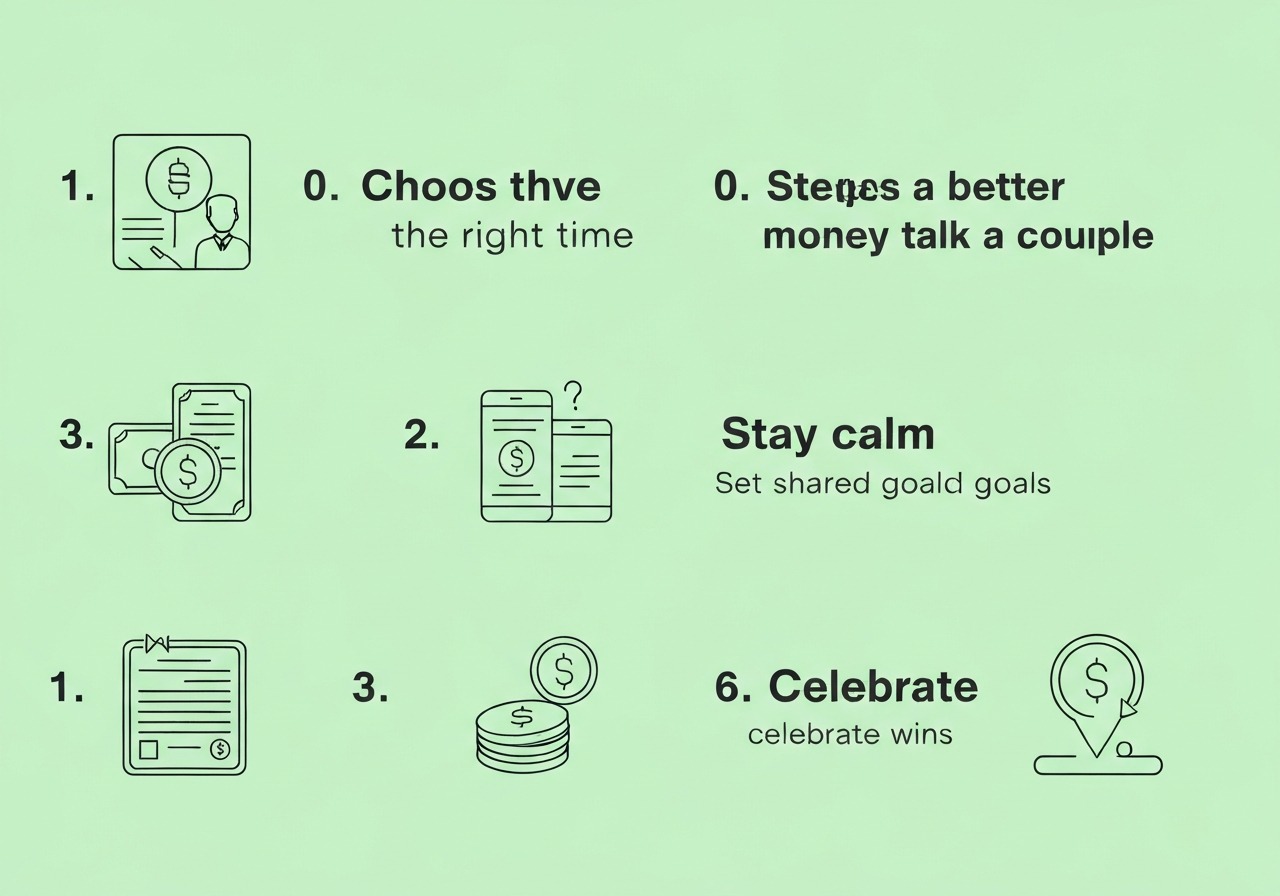
The Infographic: 5 Steps to a Better Money Talk
Best Books and Tools for Financial Communication
These resources go deeper on the principles covered in this guide.
YNAB App Subscription
Best for: Couples who want full visibility and zero-based budgeting together
Price: $14.99/month or $109/year — free 34-day trial
YNAB's shared budgeting features let both partners see every dollar in real time. The "give every dollar a job" philosophy eliminates "where did the money go?" arguments.
Check on Amazon →Couple Money: A Financial Roadmap for Couples
Best for: Couples who want a practical, relationship-focused money framework
Price: $13–$18
Pete the Planner's straightforward guide to managing money as a team. Covers how to communicate about spending, how to set shared goals, and how to divide financial responsibilities without resentment.
Check on Amazon →Dave Ramsey's Financial Peace Revisited
Best for: Couples who want a structured, step-by-step debt payoff and savings plan
Price: $13–$20
Ramsey's baby steps framework gives couples a clear priority order: emergency fund → debt snowball → investing → home. The shared milestone system makes it easy to stay aligned as a team.
Check on Amazon →Clever Girl Finance: Ditch Debt, Save Money, and Build Real Wealth
Best for: Couples where one partner (especially women) wants to build financial confidence and a stronger voice in money decisions
Price: $13–$18
Bola Sokunbi's approachable guide helps individuals — and couples — move from financial anxiety to financial confidence. Excellent for partners who feel unequal in financial knowledge or power.
Check on Amazon →Natalie Bacon Net Worth Planner
Best for: Couples who want to track net worth growth and build wealth mindset together
Price: $20–$35
A structured planner for tracking assets, liabilities, and progress toward financial independence. Use it as a shared couple's journal to document milestones and keep both partners focused on the big picture.
Check on Amazon →<video src="/videos/how-to-have-money-talk-without-fighting-demo.mp4" poster="/images/articles/money-talk-couple-hero.jpg" width="100%" controls muted autoplay loop style="border-radius:12px;margin:2rem 0;" aria-label="Video guide: How to have a money talk without fighting as a couple"
Your browser does not support the video tag.
Frequently Asked Questions
How do you talk to your partner about money without arguing?
Schedule a calm, low-pressure money date when neither partner is hungry, tired, or stressed. Use "I" statements to express your feelings without blame ("I feel anxious when we overspend" rather than "You always overspend"). Focus on shared goals rather than past mistakes. Keep the first conversation short — 20 to 30 minutes — and end on a positive note about what you are building together.
What should you discuss in a couples money talk?
Cover five key areas: (1) current financial snapshot — income, expenses, debts, savings; (2) short-term goals such as paying off a credit card or building an emergency fund; (3) long-term goals like buying a home or retiring early; (4) spending values — what each partner finds worth spending money on; and (5) financial roles — who handles which bills and accounts.
How often should couples have money talks?
Most financial experts recommend a monthly money date of 30 to 60 minutes to review the budget, check savings progress, and discuss upcoming expenses. Additionally, a brief weekly check-in of 10 to 15 minutes helps catch small issues before they become big arguments. An annual deeper review covers long-term goals, insurance, investments, and net worth.
What causes most money fights in relationships?
The four most common triggers for money fights are: (1) different spending values — one partner is a spender, the other a saver; (2) financial secrets or hidden purchases; (3) unequal contribution feelings when incomes differ significantly; and (4) unresolved debt — especially debt one partner brought into the relationship. Most fights are not really about money — they are about feeling unheard, disrespected, or powerless.
Should couples combine finances?
Research from the University of California published in 2023 found that couples who fully combine finances report higher relationship satisfaction and lower conflict around money. However, the best system is the one both partners agree on. Options include fully combined accounts, fully separate accounts, or a hybrid system where shared expenses go into a joint account and each partner keeps a personal spending account. When planning to merge money, see our guide on joint bank account vs separate for a step-by-step approach.
How do you handle different money values in a relationship?
First, acknowledge that different money values are normal — they come from childhood experiences, family patterns, and personal priorities. Avoid labelling your partner as "wrong". Instead, map your values: each partner writes down their top five spending priorities. Find the overlap — this becomes your shared budget foundation. For areas of difference, negotiate a personal spending allowance for each partner with no questions asked. This removes judgment from individual purchases.
Sources and Methodology
This article draws on data and research from the following sources:
- Ramsey Solutions — Money, Marriage, and Communication Study (2025). Data on financial conflict and relationship outcomes.
- Fidelity Investments Couples & Money Study (2024) — Survey data on financial alignment and knowledge gaps between partners.
- CreditCards.com Financial Infidelity Survey (2024) — Data on hidden accounts and secret spending in relationships.
- American Psychological Association (APA) — Stress in America survey data on financial stress in households (2025).
- University of California (2023) — Research on financial pooling and relationship satisfaction among couples.
- Consumer Financial Protection Bureau (CFPB) — Research on financial communication behaviours and outcomes.
- Journal of Financial Therapy — Multiple studies on money communication, financial therapy, and couples conflict resolution.
- Dominican University of California — Dr. Gail Matthews goal-setting study on written goals and accountability.
- YNAB / Monarch Money — Product documentation and user research on couples budgeting outcomes.
- Bureau of Labor Statistics (BLS) — Consumer Expenditure Survey (2025) for average household spending data.
All statistics cited are from 2023–2026 publications unless otherwise noted.
Sarah Chen is a Certified Financial Planner (CFP) and personal finance educator specialising in couples and family finance. She has worked with over 300 couples to reduce money conflict and build shared financial plans. Sarah contributes to Budgeting for Couples to give real couples actionable tools for navigating financial conversations with confidence.